Many who today hear me somewhere in person, or on television, or those who read something I’ve said, will think I went to school far beyond the eighth grade.
This impression is due entirely to my prison studies.
It really begun back in the Charlestown Prison, when Bimbi first made me feel envy of his stock of knowledge.
Bimbi had always taken charge of any conversations he was in, and I had tried to emulate him.
But every book
I picked up might as well have been in Chinese.
I saw that the best thing I could do was get hold of a dictionary—to study, to learn some words.
I was lucky enough to reason also that I should try to improve my penmanship.
It was sad. I couldn’t even write in a straight line!
It was both ideas together that moved me to request a dictionary along with some tablets and pencils from the Norfolk Prison Colony school.
I spent two days just riffling uncertainly through the dictionary’s
pages.
I’d never realized so many words existed!
And I didn’t know which words I needed to learn.
Finally, just to start some kind of action, I began
copying.
In my slow, painstaking, ragged handwriting, I copied into my tablet everything printed on that first page, down to the punctuation marks.
I believe it took me a day.
Then, aloud, I read
back, to myself, everything I’d written on the tablet.
Over and over, aloud, to myself, I read my own handwriting.
I woke up the next morning, thinking about those words... immensely proud to realize that not only had I written so much at one time, but I’d written words that I never knew were in
the world.
Moreover, with a little effort, I also could remember what many of these words meant.
I reviewed the words whose meanings I didn’t remember.
I was so fascinated that I went
on.
I copied the dictionary’s next page. And the same experience came when I studied that.
With every succeeding page, I also learned of people and places and events from history. Actually, the dictionary is like a miniature encyclopedia.
Finally, the dictionary’s A section had filled a whole tablet... and I went on into the B’s.
That was the way I started copying what eventually became the entire dictionary.
It went a lot faster after so much practice helped me to pick up
handwriting speed.
Between what I wrote in my tablet, and writing letters, during the rest of my time in prison I would guess I wrote a million words.
I suppose it was inevitable that as my word-base broadened, I could for the first time pick up a book and read and now begin to understand what the
book was saying.
Anyone who has read a great deal can imagine the new world that opened.
Let me tell you something: from then until I left that prison, in every free moment I had, if I was not reading in the library, I was reading on my bunk.
You couldn’t have gotten me out of books with a wedge.
Between Mr. Muhammad’s teachings, my correspondence, my visitors—usually Ella and Reginald—and my reading of books, months passed without my even thinking about being imprisoned.
In fact, up to then, I had never been so truly free in my life.
Available on the prison library’s shelves were books on just about every general subject.
No university would ask any student to devour literature as I did when this new world opened to me, of being able to
read and understand.
I read more in my room than in the library itself. I preferred reading in the total isolation of my own room.
When I had progressed to really serious reading, every night at about ten PM, I would be outraged with the call of “lights
out.”
It always seemed to catch me right in the middle of something engrossing.
Fortunately, right outside my cell was a corridor light that cast a glow into my room.
The glow was enough to read by, once my eyes adjusted to it.
So, when “lights out” came, I would sit on the floor where I could continue reading in that glow.
At one-hour intervals the night guards paced past every room.
Each time I heard the approaching footsteps, I jumped into bed and feigned
sleep.
And as soon as the guard passed, I got back out of bed onto the floor area of that light-glow, where I would read for another fifty-eight minutes... until the guard approached again.
That went on until three or four every morning.
Three or four hours of sleep a night was enough for me. Often in the years in the streets I had slept less than that.
The teachings of Mr. Muhammad stressed how history had been “whitened”.
When white men had written history books, the black man simply had been left out.
I will never forget how shocked I was when I began reading about slavery's horrors.
It was the world’s most monstrous crime
The sin, and the blood on the white man’s hands, are almost impossible to believe.
I read descriptions of atrocities.
I saw illustrations of black slave women tied up and flogged with whips...
Of black mothers watching their babies being dragged off, never to be seen by their mothers again...
Of dogs after slaves…
And of the fugitive slave catchers… evil white men with whips and clubs and chains and guns.
Book after book showed me how the white man had brought upon the world’s black, brown, red, and yellow peoples every variety of the sufferings of exploitation.
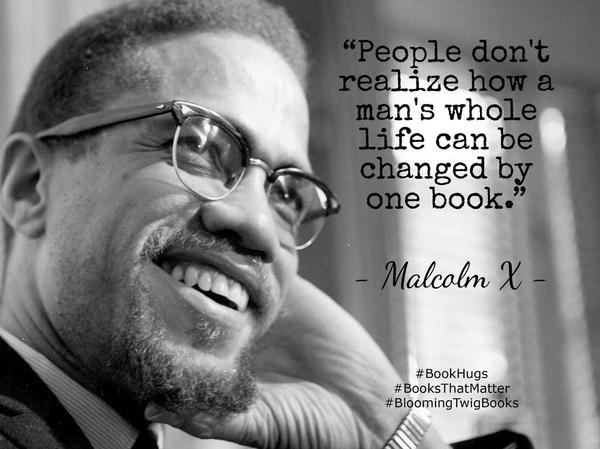
I have often reflected upon the new vistas that reading opened to me.
I knew
right there in prison that reading had changed forever the course of my life.
As I see it today, the ability to read awoke inside me some long dormant craving to be mentally alive.
I certainly wasn’t seeking any degree, the way a college confers a status symbol upon its
students.
My homemade education gave me, with every additional book that I read, a little bit more sensitivity to the deafness, dumbness, and blindness that was afflicting the black race in America.
Not long ago, an English writer telephoned me from London, asking
questions.
One was, “What’s your alma mater?”
I told him, “Books.”